Since my early days of online combat flight simulator flying starting in IL2 Cliffs of Dover and moving on to DCS, there have been heated debates about which aircraft should be in the plane set for the particular period of WWII that a given map is supposed to represent.
For example, in the early Cliffs of Dover many allied flyers wanted the Spitfire II and the axis the Bf109-E4/N, as these two aircraft were the best performers in each air force. Luckily, in campaign servers like Storm of War, the mission builders restricted the numbers of these aircraft to realistic wartime proportions, so that they were the exception rather than the rule and most of us flew lesser performing types like the Hurricane, Spitfire I, Bf109-E3 and E4.
So while the IL2 flight simulator game editors have understood the need for contemporary aircraft types, there is a lack of such logic in DCS, which is probably the better combat aircraft flight simulator, due to higher quality in terms of aircraft flight models, visuals, map and weather details. That DCS may only be interested in portraying particular versions of iconic WWII aircraft such as the Bf109-K4, or the Spitfire LF IX, would tend to indicate that they might not be interested in combat flight simulation gameplay, and yet they do spend time and effort on developing period aircraft, maps, mission building and mission server hosting tools for WWII scenarios.
To further illustrate the lack of logic at DCS, when they released the excellently detailed Channel Map, the marketing blurb talked about the geographical area where the aerial combats took place during the Battle of Britain in 1940. Sadly there are no early WWII type aircraft available in DCS and hardly any of the classic airfields of the time are represented. The map is more relative with the 1942-44 period airbases when the Americans entered the war and at least the Spitfire IX, Fw190-A, P-47 and P-51 were contemporary for this period, even if the DCS versions of the last three were not strictly correct. The main problem with this period being that the Fw190-D and again the Bf109-K4, both accurately modeled in DCS, are not compatible. The correct Bf109’s should be the F3 and G6 models and the Fw190-D versions only started in squadron service in late 1944. This is also true for the DCS Normandy maps which are historically accurate for the 1942- aug 44 period.
So while it is not difficult to find the contemporary aircraft types that should be matched, if game editors don’t do so, are their performance differences really that different, such as to give an unfair gameplay advantage ? There are at least two historical occasions where a significant performance difference did exist, but this was more the exception than the rule. The first being the arrival of the Fw190-A3 in late 1941 which completely outclassed the Spitfire V until the arrival of the Spitfire IX in mid 1942. The superiority of the Fw190 was so marked that the RAF had to cease offensive operations over Northern Europe for several months. The second was the arrival of the Me262 jet in 1945. Luckily it arrived too late in the war and in too small numbers, thanks to allied bombing of production sites and airfields, to be of any influence in the course of the war. However aside from these two, the dramatic increases in performance of axis and allied aircraft during the war were fairly balanced in time as each strove to get the upper edge.
For my personal interest I decided to compile a table of the best single piston engined fighters used in western Europe during WWII to see if the basic performance differences were really that marked. While I am no aircraft engineer or airframe designer, I have included factors that seem important for comparison such as aircraft operating weights, wing loading, maximum engine power, best maximum airspeeds (albeit at different heights and with injected additives), and some ratios like thrust to weight. If you are really interested in understanding the technical differences between these aircraft I strongly recommend that you watch the excellent videos by Greg’s Airplanes.
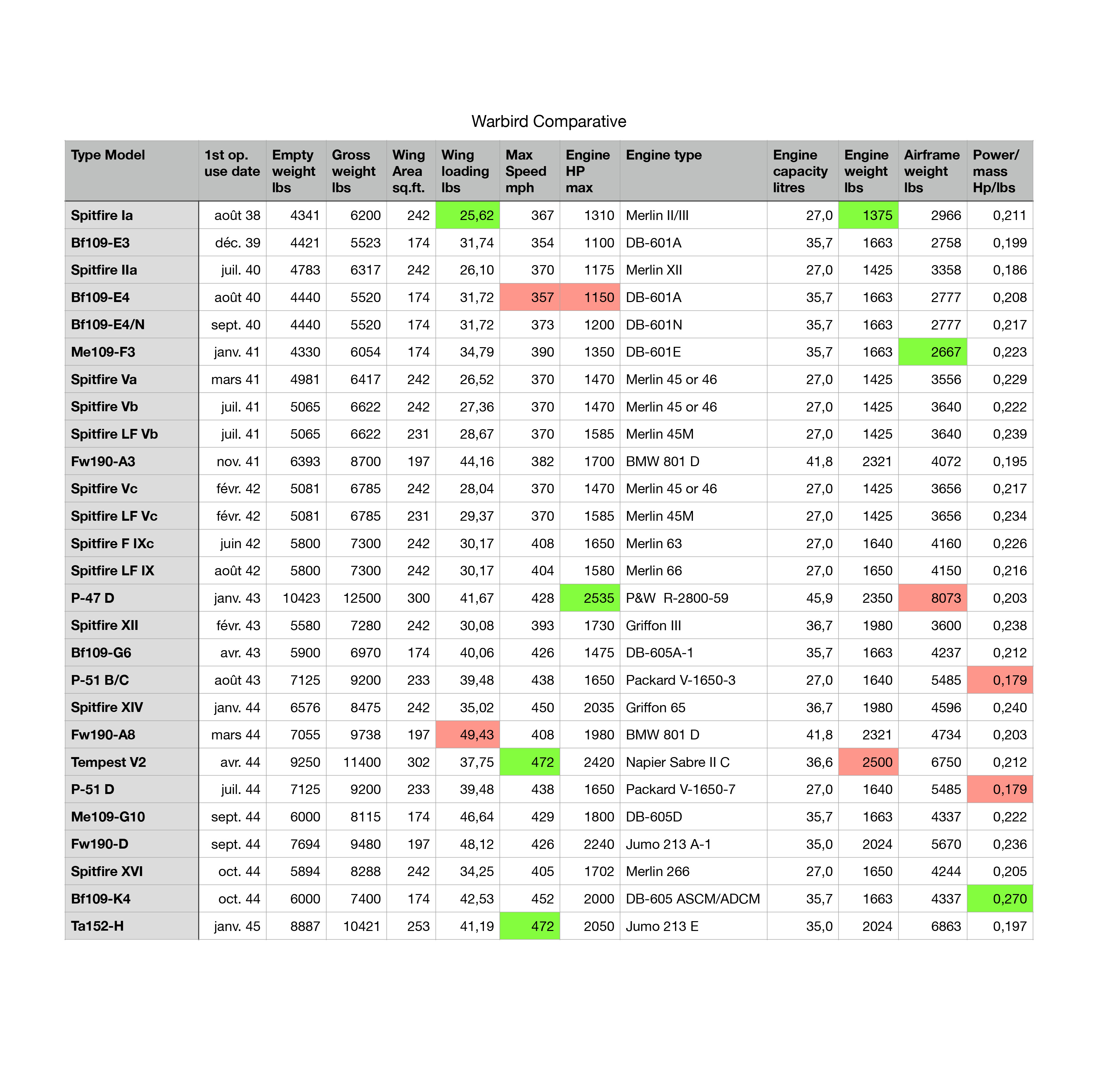
The table shows that for example both Spitfire and Bf109 progressively almost doubled engine power and increased speed by about 100 mph, thus keeping pace with more recently designed aircraft like the Fw190, P-47 Thunderbolt, P-51 Mustang and Hawker Tempest. So the figures do tend to confirm the importance of matching aircraft versions for the same period, even if the outcome of a combat will also depend on how pilots take into account the strong and weak points of their own and opposing aircraft. Faster aircraft allow pilots to choose when to fight or to disengage.
In the table I tried to get some indication about airframe speed potential or drag coefficients, but didn’t really find anything conclusive in the data I had collated. Finding accurate data is not that easy, as information varies a fair amount from one source to another. Suffice to say that whatever power-plant or method for gaining extra speed, like diving, most WWII airframes were limited to about 450 mph. One aircraft got close to the speed of sound in a dive at the hands of a test pilot – this was a Spitfire XI which suffered serious engine vibration and failure, but it managed to land minus its propeller and reduction gear.
Surprisingly, although engines got bigger, more powerful and heavier, only the Bf 109-K series with the DB-605 ASCM or ADCM engines really managed to achieve an excessive power to weight ratio margin on its competitors. As Greg explains very well, the Germans needed to have bigger capacity engines as their fuel octane rating (around 87) was significantly lower than those used by the allies (100 and in some cases 150 octane). The Germans tried to get round this problem by adding water, water-methanol or nitrous oxide injection.
So back to the contemporary aircraft version issue, IL2 designers have integrated this and DCS not. DCS are proudly celebrating their 15th anniversary, so they seem to know how to run their business. Yet, from a purely commercial point of view I fail to understand why DCS doesn’t match up aircraft versions and maps, as if they did, in my view, they would certainly sell more maps and aircraft and make more money. Or is it simply a fact that a majority of modern flight simulator players have little or no interest in historically accurate scenarios for WWII and that they are probably more interested in fast jets ? So why do DCS keep bringing out new and enhanced WWII maps and aircraft types ? What do you think ?